 Add to Chrome
 Add to Firefox
 Add to Edge
ChartArena: Benchmarking Chart Parsing across Languages, Scenarios, and Formats
May 31, 2026
Charts are a primary medium for conveying quantitative and relational information, yet systematically evaluating chart parsing models remains difficult. Existing benchmarks focus on narrow chart types and leave diagrammatic structures such as flowcharts and mind maps largely unaddressed, while models produce outputs in incompatible formats, and datasets rarely include the printed or hand-drawn images encountered in practice. To address these issues, we introduce ChartArena, a comprehensive bilingual benchmark covering eight chart families spanning both numeric charts and diagrammatic structures, each evaluated across three visual scenarios: digital renderings, printed photos, and hand-drawn photos. The dataset is built via a human-agent collaborative annotation pipeline with multi-stage human verification to ensure annotation reliability. To enable fair cross-model comparison, we further design a format-agnostic evaluation protocol that maps heterogeneous outputs into two canonical semantic spaces, a normalized triple view and a directed graph view, and scores them with structure-aware metrics. Through extensive evaluation of 26 leading MLLMs, we observe three consistent findings: (i) frontier proprietary models such as Gemini 3.1 Pro lead overall, yet the strongest open-source systems are rapidly closing the gap; (ii) document parsing models handle numeric charts reasonably but fall sharply behind on diagrammatic structures; and (iii) expert chart parsers remain limited to narrow chart families. Across all models, radar charts and hand-drawn scenarios stay especially challenging. These findings show that ChartArena exposes clear capability gaps and provides a unified foundation for future progress. ChartArena is publicly available at https://github.com/pspdada/ChartArena.

PhoneWorld: Scaling Phone-Use Agent Environments
May 28, 2026A central bottleneck for phone-use agents is that controllable, reproducible environments covering real mobile behavior are hard to build at scale. Existing mobile-agent benchmarks have made important progress on evaluation, but they do not by themselves provide a scalable way to construct many new phone-use environments. We present PhoneWorld, a reusable pipeline that converts real GUI trajectories and screenshots into controllable phone-use environments, executable tasks, automatic verifiers, and training rollouts. Rather than hand-building one mobile benchmark at a time, PhoneWorld uses real trajectories to recover which screens matter, how screens connect, which interactions must change environment state, and which user goals admit automatic verification. From these signals, it builds runnable mock Android apps backed by read-only app content and mutable state, then derives executable tasks, rule-based verifiers, and training rollouts from the same environments. In its current instantiation, PhoneWorld covers 34 apps across 16 domains, spanning common consumer mobile behaviors such as search, browsing, shopping, booking, media, and social interaction. Under a fixed training budget, replacing 10K steps from an auxiliary AndroidWorld corpus in an AndroidWorld-based baseline with broad PhoneWorld supervision improves all four evaluation benchmarks at once, raising HYMobileBench by 17.7 points, AndroidControl by 6.0 points, AndroidWorld by 14.7 points, and PhoneWorld by 52.5 points. We then study two additional scaling questions: increasing the amount of PhoneWorld supervision strongly improves PhoneWorld performance, and under a fixed PhoneWorld budget, expanding app coverage yields even larger gains. Overall, PhoneWorld shifts the focus from building one mobile benchmark at a time to scaling the supply of phone-use environments themselves.
Towards Real-World Document Parsing via Realistic Scene Synthesis and Document-Aware Training
Mar 25, 2026Document parsing has recently advanced with multimodal large language models (MLLMs) that directly map document images to structured outputs. Traditional cascaded pipelines depend on precise layout analysis and often fail under casually captured or non-standard conditions. Although end-to-end approaches mitigate this dependency, they still exhibit repetitive, hallucinated, and structurally inconsistent predictions - primarily due to the scarcity of large-scale, high-quality full-page (document-level) end-to-end parsing data and the lack of structure-aware training strategies. To address these challenges, we propose a data-training co-design framework for robust end-to-end document parsing. A Realistic Scene Synthesis strategy constructs large-scale, structurally diverse full-page end-to-end supervision by composing layout templates with rich document elements, while a Document-Aware Training Recipe introduces progressive learning and structure-token optimization to enhance structural fidelity and decoding stability. We further build Wild-OmniDocBench, a benchmark derived from real-world captured documents for robustness evaluation. Integrated into a 1B-parameter MLLM, our method achieves superior accuracy and robustness across both scanned/digital and real-world captured scenarios. All models, data synthesis pipelines, and benchmarks will be publicly released to advance future research in document understanding.
MMTIT-Bench: A Multilingual and Multi-Scenario Benchmark with Cognition-Perception-Reasoning Guided Text-Image Machine Translation
Mar 25, 2026End-to-end text-image machine translation (TIMT), which directly translates textual content in images across languages, is crucial for real-world multilingual scene understanding. Despite advances in vision-language large models (VLLMs), robustness across diverse visual scenes and low-resource languages remains underexplored due to limited evaluation resources. We present MMTIT-Bench, a human-verified multilingual and multi-scenario benchmark with 1,400 images spanning fourteen non-English and non-Chinese languages and diverse settings such as documents, scenes, and web images, enabling rigorous assessment of end-to-end TIMT. Beyond benchmarking, we study how reasoning-oriented data design improves translation. Although recent VLLMs have begun to incorporate long Chain-of-Thought (CoT) reasoning, effective thinking paradigms for TIMT are still immature: existing designs either cascade parsing and translation in a sequential manner or focus on language-only reasoning, overlooking the visual cognition central to VLLMs. We propose Cognition-Perception-Reasoning for Translation (CPR-Trans), a data paradigm that integrates scene cognition, text perception, and translation reasoning within a unified reasoning process. Using a VLLM-driven data generation pipeline, CPR-Trans provides structured, interpretable supervision that aligns perception with reasoning. Experiments on 3B and 7B models show consistent gains in accuracy and interpretability. We will release MMTIT-Bench to promote the multilingual and multi-scenario TIMT research upon acceptance.
Does the Question Really Matter? Training-Free Data Selection for Vision-Language SFT
Mar 10, 2026Visual instruction tuning is crucial for improving vision-language large models (VLLMs). However, many samples can be solved via linguistic patterns or common-sense shortcuts, without genuine cross-modal reasoning, limiting the effectiveness of multimodal learning. Prior data selection methods often rely on costly proxy model training and focus on difficulty or diversity, failing to capture a sample's true contribution to vision-language joint reasoning. In this paper, we propose CVS, a training-free data selection method based on the insight that, for high-quality multimodal samples, introducing the question should substantially alter the model's assessment of answer validity given an image. CVS leverages a frozen VLLM as an evaluator and measures the discrepancy in answer validity with and without conditioning on the question, enabling the identification of samples that require vision-language joint reasoning while filtering semantic-conflict noise. Experiments on Vision-Flan and The Cauldron show that CVS achieves solid performance across datasets. On Vision-Flan, CVS outperforms full-data training by 3.5% and 4.8% using only 10% and 15% of the data, respectively, and remains robust on the highly heterogeneous Cauldron dataset. Moreover, CVS reduces computational cost by 17.3% and 44.4% compared to COINCIDE and XMAS.
Gather and Trace: Rethinking Video TextVQA from an Instance-oriented Perspective
Aug 06, 2025Video text-based visual question answering (Video TextVQA) aims to answer questions by explicitly reading and reasoning about the text involved in a video. Most works in this field follow a frame-level framework which suffers from redundant text entities and implicit relation modeling, resulting in limitations in both accuracy and efficiency. In this paper, we rethink the Video TextVQA task from an instance-oriented perspective and propose a novel model termed GAT (Gather and Trace). First, to obtain accurate reading result for each video text instance, a context-aggregated instance gathering module is designed to integrate the visual appearance, layout characteristics, and textual contents of the related entities into a unified textual representation. Then, to capture dynamic evolution of text in the video flow, an instance-focused trajectory tracing module is utilized to establish spatio-temporal relationships between instances and infer the final answer. Extensive experiments on several public Video TextVQA datasets validate the effectiveness and generalization of our framework. GAT outperforms existing Video TextVQA methods, video-language pretraining methods, and video large language models in both accuracy and inference speed. Notably, GAT surpasses the previous state-of-the-art Video TextVQA methods by 3.86\% in accuracy and achieves ten times of faster inference speed than video large language models. The source code is available at https://github.com/zhangyan-ucas/GAT.
Beyond Cropped Regions: New Benchmark and Corresponding Baseline for Chinese Scene Text Retrieval in Diverse Layouts
Jun 05, 2025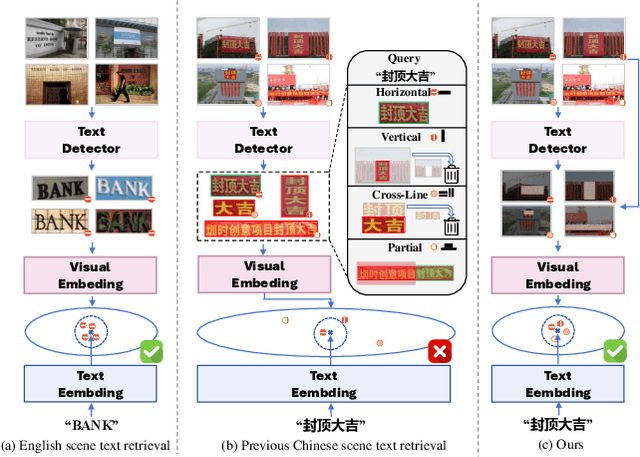
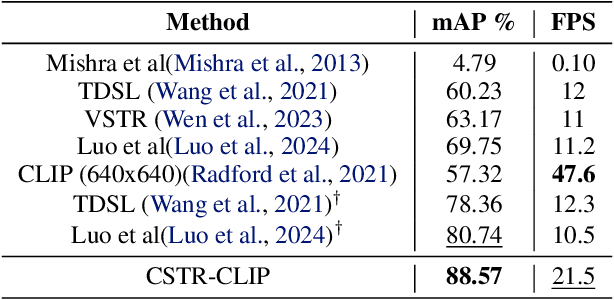
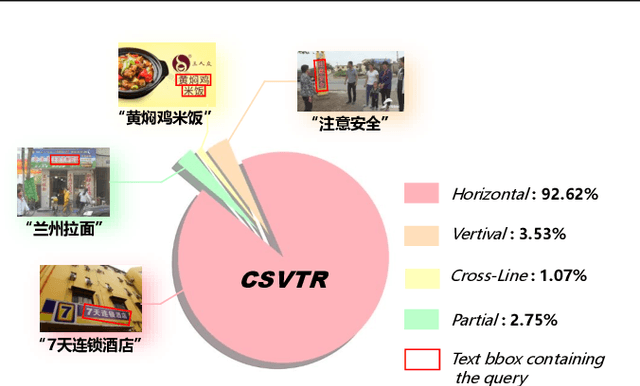
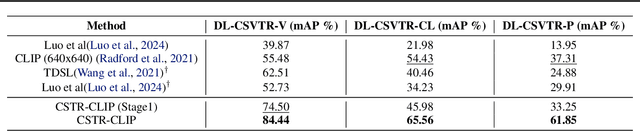
Chinese scene text retrieval is a practical task that aims to search for images containing visual instances of a Chinese query text. This task is extremely challenging because Chinese text often features complex and diverse layouts in real-world scenes. Current efforts tend to inherit the solution for English scene text retrieval, failing to achieve satisfactory performance. In this paper, we establish a Diversified Layout benchmark for Chinese Street View Text Retrieval (DL-CSVTR), which is specifically designed to evaluate retrieval performance across various text layouts, including vertical, cross-line, and partial alignments. To address the limitations in existing methods, we propose Chinese Scene Text Retrieval CLIP (CSTR-CLIP), a novel model that integrates global visual information with multi-granularity alignment training. CSTR-CLIP applies a two-stage training process to overcome previous limitations, such as the exclusion of visual features outside the text region and reliance on single-granularity alignment, thereby enabling the model to effectively handle diverse text layouts. Experiments on existing benchmark show that CSTR-CLIP outperforms the previous state-of-the-art model by 18.82% accuracy and also provides faster inference speed. Further analysis on DL-CSVTR confirms the superior performance of CSTR-CLIP in handling various text layouts. The dataset and code will be publicly available to facilitate research in Chinese scene text retrieval.
Char-SAM: Turning Segment Anything Model into Scene Text Segmentation Annotator with Character-level Visual Prompts
Dec 27, 2024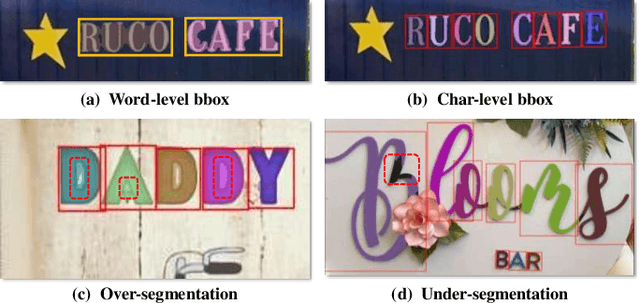
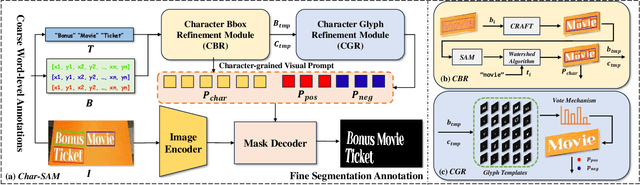
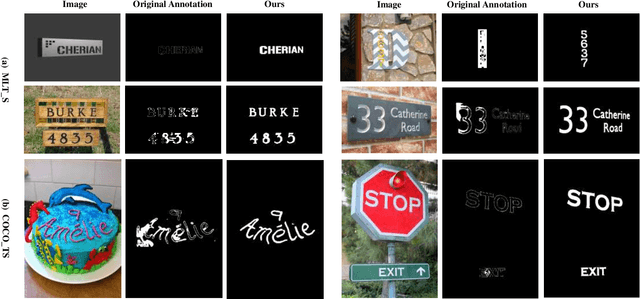
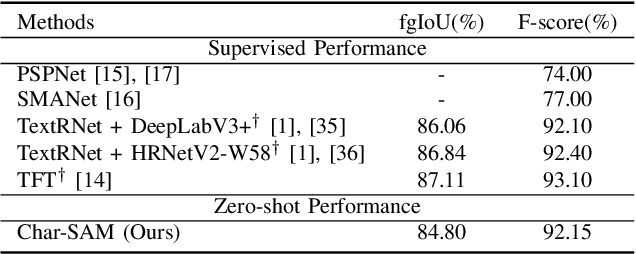
The recent emergence of the Segment Anything Model (SAM) enables various domain-specific segmentation tasks to be tackled cost-effectively by using bounding boxes as prompts. However, in scene text segmentation, SAM can not achieve desirable performance. The word-level bounding box as prompts is too coarse for characters, while the character-level bounding box as prompts suffers from over-segmentation and under-segmentation issues. In this paper, we propose an automatic annotation pipeline named Char-SAM, that turns SAM into a low-cost segmentation annotator with a Character-level visual prompt. Specifically, leveraging some existing text detection datasets with word-level bounding box annotations, we first generate finer-grained character-level bounding box prompts using the Character Bounding-box Refinement CBR module. Next, we employ glyph information corresponding to text character categories as a new prompt in the Character Glyph Refinement (CGR) module to guide SAM in producing more accurate segmentation masks, addressing issues of over-segmentation and under-segmentation. These modules fully utilize the bbox-to-mask capability of SAM to generate high-quality text segmentation annotations automatically. Extensive experiments on TextSeg validate the effectiveness of Char-SAM. Its training-free nature also enables the generation of high-quality scene text segmentation datasets from real-world datasets like COCO-Text and MLT17.
LDP: Generalizing to Multilingual Visual Information Extraction by Language Decoupled Pretraining
Dec 19, 2024Visual Information Extraction (VIE) plays a crucial role in the comprehension of semi-structured documents, and several pre-trained models have been developed to enhance performance. However, most of these works are monolingual (usually English). Due to the extremely unbalanced quantity and quality of pre-training corpora between English and other languages, few works can extend to non-English scenarios. In this paper, we conduct systematic experiments to show that vision and layout modality hold invariance among images with different languages. If decoupling language bias from document images, a vision-layout-based model can achieve impressive cross-lingual generalization. Accordingly, we present a simple but effective multilingual training paradigm LDP (Language Decoupled Pre-training) for better utilization of monolingual pre-training data. Our proposed model LDM (Language Decoupled Model) is first pre-trained on the language-independent data, where the language knowledge is decoupled by a diffusion model, and then the LDM is fine-tuned on the downstream languages. Extensive experiments show that the LDM outperformed all SOTA multilingual pre-trained models, and also maintains competitiveness on downstream monolingual/English benchmarks.
Track the Answer: Extending TextVQA from Image to Video with Spatio-Temporal Clues
Dec 17, 2024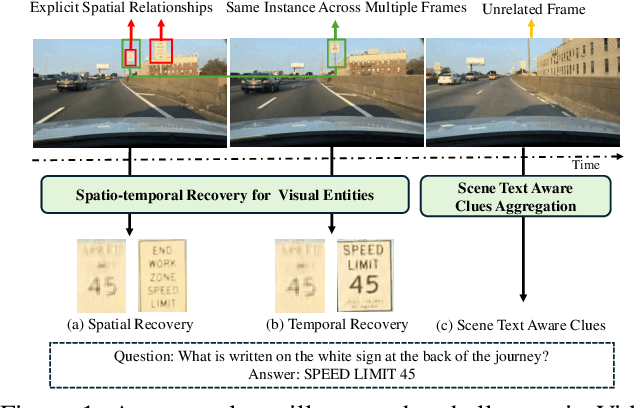

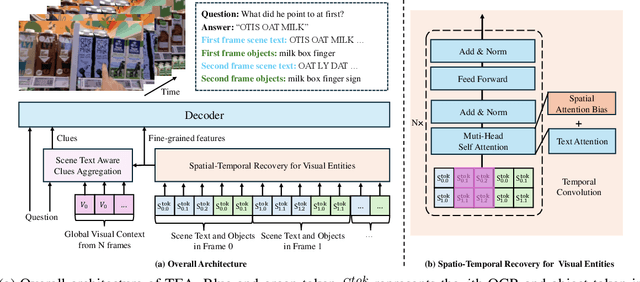

Video text-based visual question answering (Video TextVQA) is a practical task that aims to answer questions by jointly reasoning textual and visual information in a given video. Inspired by the development of TextVQA in image domain, existing Video TextVQA approaches leverage a language model (e.g. T5) to process text-rich multiple frames and generate answers auto-regressively. Nevertheless, the spatio-temporal relationships among visual entities (including scene text and objects) will be disrupted and models are susceptible to interference from unrelated information, resulting in irrational reasoning and inaccurate answering. To tackle these challenges, we propose the TEA (stands for ``\textbf{T}rack th\textbf{E} \textbf{A}nswer'') method that better extends the generative TextVQA framework from image to video. TEA recovers the spatio-temporal relationships in a complementary way and incorporates OCR-aware clues to enhance the quality of reasoning questions. Extensive experiments on several public Video TextVQA datasets validate the effectiveness and generalization of our framework. TEA outperforms existing TextVQA methods, video-language pretraining methods and video large language models by great margins.